You've just published what you believe is your most comprehensive, well-researched article yet. Three weeks later, a colleague mentions they saw Claude reference your exact methodology in a conversation—but you had no idea it happened. No notification. No analytics spike. No way to know which of your 50+ articles Claude actually cites, or why this one made the cut.
This is the AI citation blind spot that's quietly reshaping content strategy in 2026.
Unlike traditional SEO where you can track rankings, backlinks, and referral traffic, AI citations happen inside conversational interfaces that function like black boxes. Your content might be influencing thousands of AI-powered decisions daily, shaping how Claude responds to queries in your industry, yet you're operating completely blind to this impact.
The stakes are higher than most content creators realize. As conversational AI becomes a primary information discovery channel—with Claude processing millions of queries across professional and consumer contexts—the inability to track citations represents a critical gap in content intelligence. Your competitors who crack this code gain visibility into what makes content citation-worthy, which topics AI models prioritize, and how to systematically optimize for AI discovery.
The good news? Claude AI citation tracking methods exist, and they're more accessible than you might think. This isn't about gaming an algorithm or reverse-engineering proprietary systems. It's about understanding how Claude evaluates, selects, and attributes sources—then building systematic processes to monitor, measure, and optimize your content's citation performance.
Here's everything you need to know about Claude AI citation tracking methods, from the fundamentals of how Claude's citation engine operates to advanced analytics frameworks that transform citation data into strategic competitive advantages. You'll learn both manual monitoring techniques you can implement immediately and automated tracking systems that scale across large content portfolios.
Understanding Claude's Citation Mechanism
Claude's citation system operates fundamentally differently from traditional search engines or even other AI models. While Google ranks pages based on authority signals and backlinks, Claude evaluates sources through a multi-layered relevance and reliability framework that prioritizes content quality, factual accuracy, and contextual appropriateness for each specific query.
The citation engine analyzes content across several dimensions simultaneously. First, it assesses topical relevance—how precisely your content addresses the user's query context. Second, it evaluates source credibility through signals like publication date, author expertise indicators, and cross-reference consistency with other authoritative sources. Third, it considers presentation quality, including content structure, clarity of explanation, and supporting evidence depth.
What makes Claude's approach unique is its dynamic citation selection. Unlike static search results, Claude doesn't simply retrieve the "top 10" sources for a topic. Instead, it selects citations based on the specific conversational context, user expertise level, and query intent. The same article might be cited for one query but not another closely related one, depending on how well it matches the nuanced requirements of each conversation.
This contextual citation behavior creates both challenges and opportunities for content creators. You can't optimize for a single "citation ranking" because no such universal ranking exists. However, understanding the patterns in how Claude selects sources for different query types allows you to create content that performs consistently across multiple citation scenarios.
The citation attribution format Claude uses also matters for tracking purposes. When Claude cites a source, it typically includes the source title, publication, and sometimes a brief context note about why that source is relevant. This attribution structure provides valuable metadata you can use to identify when your content appears in Claude's responses, even without direct notification systems.
Manual Citation Tracking Techniques
Before investing in automated solutions, you can implement several manual tracking methods that provide immediate visibility into your content's citation performance. These approaches require more time investment but offer granular control and deep qualitative insights that complement quantitative metrics.
The systematic query testing method involves creating a comprehensive list of queries related to your content topics, then manually submitting these queries to Claude and documenting which sources it cites. Start by identifying 20-30 core queries that represent your target topics and user intents. For each query, record not just whether your content was cited, but also which competing sources appeared, the citation context Claude provided, and the position of your content relative to other sources.
This manual approach reveals patterns that automated tools might miss. You'll notice that certain query phrasings consistently trigger citations while others don't, even when covering the same topic. You'll identify which content formats Claude prefers for different query types—whether it favors comprehensive guides, data-driven reports, or practical tutorials. These qualitative insights inform content optimization decisions that pure citation counts can't provide.
The competitive citation analysis technique extends this approach by systematically comparing your citation performance against key competitors. Select 5-10 competitors in your space and track which of their articles Claude cites for your target queries. Document the characteristics of frequently-cited competitor content: article length, structure, evidence types, publication dates, and topical angles. This competitive intelligence reveals the citation performance bar in your industry and identifies gaps in your current content strategy.
For teams managing larger content portfolios, the citation tracking spreadsheet becomes essential. Create a structured tracking system with columns for query text, date tested, cited sources, your content's citation status, citation context, and competitor citations. Update this spreadsheet weekly or bi-weekly to build a longitudinal dataset that reveals citation trends over time. This historical data becomes invaluable for identifying which content updates improve citation rates and which topics show declining citation performance.
The citation context documentation method focuses on capturing not just whether you were cited, but how Claude framed your content. When your article appears in a Claude response, record the exact attribution text, the surrounding context, and how Claude characterized your source. This qualitative data reveals how Claude "understands" your content and whether that understanding aligns with your intended positioning. Misalignments between your content's intended focus and how Claude describes it signal opportunities for clarity improvements.
Automated Citation Monitoring Systems
As your content portfolio scales, manual tracking becomes impractical. Automated citation monitoring systems provide continuous visibility across hundreds or thousands of queries, enabling data-driven optimization at scale. These systems range from simple notification tools to comprehensive ai mention tracking software that integrate citation data with broader content performance metrics.
The foundation of any automated system is query automation. Rather than manually testing queries, automated systems submit predefined query lists to Claude's API at regular intervals, capturing responses and parsing them for citations. The sophistication lies in query list design—effective systems don't just test obvious branded queries but include hundreds of informational, comparison, and problem-solving queries that represent real user search intents in your domain.
Citation extraction and parsing represents the technical core of these systems. Since Claude's responses are conversational rather than structured data, automated systems must use natural language processing to identify citation patterns within responses. This involves detecting source attribution phrases, extracting URLs or titles, and determining citation context. Advanced systems use machine learning models trained on thousands of Claude responses to achieve high accuracy in citation detection, even as Claude's response formats evolve.
The notification and alerting layer ensures you know immediately when citation patterns change. Effective systems send alerts when your content gets cited for new queries, when citation rates drop for previously successful content, or when competitors gain citations for your target queries. These real-time notifications enable rapid response to citation opportunities and threats, rather than discovering changes weeks later through periodic manual checks.
Integration with existing analytics platforms amplifies the value of citation data. When you can view citation metrics alongside traditional SEO metrics, social engagement data, and conversion analytics, you gain a complete picture of content performance across all discovery channels. This integrated view reveals correlations between citation performance and other success metrics, helping you prioritize optimization efforts based on comprehensive impact rather than isolated channel performance.
The most sophisticated automated systems include predictive content performance analytics that forecast citation potential before publication. By analyzing patterns in your historical citation data and comparing new content against citation-successful articles, these systems can predict which drafts are likely to achieve strong citation performance and which need revision before publication. This predictive capability transforms citation tracking from a reactive monitoring tool into a proactive content optimization system.
Citation Performance Metrics and Analytics
Raw citation counts tell only part of the story. Sophisticated citation analytics frameworks transform tracking data into actionable insights by measuring performance across multiple dimensions and contextualizing citations within broader content strategy objectives.
The citation rate metric measures what percentage of relevant queries result in citations of your content. This normalized metric accounts for query volume differences across topics, enabling fair comparison between niche and broad content pieces. A technical article that gets cited in 40% of 50 highly specific queries may be more strategically valuable than a general article cited in 10% of 500 broad queries, even though the latter has higher absolute citation counts.
Citation position tracking documents where your content appears relative to other cited sources in Claude's responses. Claude often cites multiple sources per response, and position matters—sources cited first or with more prominent context receive more user attention. Tracking your average citation position over time reveals whether your content authority is growing or declining relative to competitors, even when absolute citation counts remain stable.
The citation context quality metric evaluates how Claude frames your content when citing it. High-quality citations include specific context about your content's unique value, quote key insights, or position your source as authoritative. Low-quality citations mention your content generically or cite it alongside many other sources without differentiation. This qualitative metric often correlates more strongly with actual traffic and authority gains than raw citation counts.
Query diversity analysis examines the range of query types that trigger citations of your content. Content cited across diverse query types—informational, comparison, troubleshooting, and decision-making queries—demonstrates broader utility and authority than content cited only for narrow query categories. This metric helps identify whether your content serves as a comprehensive resource or fills only a specific niche role.
The competitive citation share metric benchmarks your citation performance against key competitors. For your target query set, what percentage of citations go to your content versus competitor content? Tracking this share over time reveals whether your content strategy is gaining or losing ground in the AI citation landscape. Significant share shifts often precede similar movements in traditional search rankings, making this a leading indicator of broader content performance trends.
Citation velocity measures how quickly your content gains citations after publication. Content that achieves strong citation rates within days of publication demonstrates strong topical relevance and content quality signals that Claude's system recognizes immediately. Content that gains citations slowly or only after significant promotion may need optimization to better match Claude's quality and relevance criteria.
Optimizing Content for Citation Success
Understanding citation patterns is valuable only if you can translate insights into content improvements that increase citation rates. Citation optimization isn't about gaming the system—it's about creating content that genuinely deserves citation through superior quality, relevance, and utility.
The structural clarity optimization focuses on making your content's value proposition and key insights immediately apparent. Claude's citation system appears to favor content where the main points, supporting evidence, and practical applications are clearly structured and easy to extract. This means using descriptive headings that signal content value, leading with key insights rather than lengthy introductions, and organizing information in logical, scannable hierarchies.
Evidence density and quality significantly impact citation rates. Content that includes specific data points, research citations, expert quotes, and concrete examples gets cited more frequently than opinion-based or general advice content. The evidence doesn't need to be academic—case studies, original research, and detailed practical examples all serve as credible evidence that strengthens citation worthiness. The key is specificity and verifiability rather than vague generalizations.
Topical comprehensiveness creates citation opportunities across multiple query types. Rather than covering topics superficially, citation-successful content addresses topics from multiple angles: foundational concepts, practical applications, common challenges, advanced techniques, and comparative analysis. This comprehensive approach means your content can be cited for beginner queries, intermediate problem-solving queries, and advanced optimization queries within the same topic area.
The recency and maintenance optimization recognizes that Claude's system appears to favor recently published or updated content, particularly for rapidly evolving topics. Implementing a systematic content refresh schedule—updating statistics, adding new examples, incorporating recent developments—keeps content citation-competitive. The update frequency should match topic evolution speed: quarterly for fast-moving topics, annually for stable foundational content.
Citation-friendly formatting makes your content easier for Claude's system to parse and understand. This includes using semantic HTML structure, implementing clear schema markup, maintaining consistent terminology throughout the piece, and avoiding ambiguous references. While Claude can understand complex content, reducing parsing friction through clear formatting appears to improve citation rates, particularly for technical or specialized topics.
The authority signal optimization focuses on strengthening credibility indicators that Claude's system likely evaluates. This includes author bio optimization with relevant expertise signals, linking to authoritative sources to demonstrate research quality, maintaining factual accuracy through fact-checking processes, and building topical authority through comprehensive coverage of related subjects. These signals collectively communicate that your content deserves citation as a reliable source.
Advanced Citation Tracking Strategies
Beyond basic monitoring and optimization, advanced citation tracking strategies leverage citation data for competitive intelligence, content strategy planning, and predictive performance modeling. These approaches transform citation tracking from a measurement activity into a strategic advantage.
The citation gap analysis identifies topics where competitors achieve strong citation rates but your content is absent or underperforming. By systematically mapping competitor citations across your target topic space, you identify high-value content opportunities where creating or improving content could capture citation share. This approach is particularly valuable for discovering emerging topics where early comprehensive content can establish citation dominance before competition intensifies.
Citation pattern modeling uses machine learning to identify the characteristics that predict citation success in your specific domain. By analyzing hundreds of citation instances and the content characteristics associated with them, you can build predictive models that score new content drafts for citation potential. These models might reveal that in your industry, articles with specific structural patterns, evidence types, or length ranges consistently outperform others, enabling data-driven content planning.
The multi-model citation tracking strategy extends monitoring beyond Claude to include other AI systems like ChatGPT, Perplexity, and emerging models. Since different AI systems may have different citation criteria and source preferences, tracking across multiple platforms reveals which content characteristics drive universal citation success versus platform-specific performance. This multi-platform brand tracking software approach future-proofs your content strategy as the AI landscape evolves.
Citation attribution optimization focuses on ensuring that when Claude cites your content, it attributes it in ways that maximize brand recognition and authority perception. This involves optimizing article titles for clarity and memorability, ensuring author and publication information is prominently displayed, and structuring content so Claude's system can easily extract and attribute key insights to your brand rather than presenting them as general knowledge.
The citation network analysis examines not just which of your articles get cited, but how citations connect across your content portfolio. When Claude cites one of your articles, does it also reference related articles from your site, creating a citation cluster that reinforces topical authority? Or are citations isolated, suggesting weak internal content connections? This network perspective informs internal linking strategy and content hub development to maximize cumulative citation impact.
Temporal citation analysis tracks how citation patterns evolve over time, revealing content lifecycle patterns. Some content achieves immediate citation success then declines as newer content emerges. Other content gains citations gradually as it accumulates authority signals. Understanding these temporal patterns helps you predict when content will need refreshing, when to invest in promotion versus creation, and how to sequence content publication for maximum cumulative citation impact.
Integration with Broader Content Strategy
Citation tracking delivers maximum value when integrated with your broader content strategy rather than treated as an isolated metric. The most sophisticated content organizations use citation data to inform decisions across the entire content lifecycle, from ideation through optimization and sunsetting.
In the content planning phase, citation data reveals which topics and content types deliver the strongest AI visibility. Rather than relying solely on traditional keyword research or search volume data, you can prioritize topics where your existing content achieves strong citation rates or where competitor citation analysis reveals high-value opportunities. This citation-informed planning ensures you're creating content optimized for the full discovery landscape, not just traditional search.
During content creation, citation benchmarks provide quality targets for writers and editors. Rather than vague instructions to "create comprehensive content," you can specify that content should match or exceed the evidence density, structural clarity, and topical comprehensiveness of your top-cited articles. This data-driven approach to content quality standards raises the baseline performance of your entire content portfolio.
The content promotion strategy should account for citation performance alongside traditional metrics. Content that achieves strong citation rates deserves additional promotion investment because it's demonstrating AI visibility that will compound over time. Conversely, content with weak citation performance despite strong traditional metrics may need optimization before further promotion investment. This integrated view prevents resource misallocation based on incomplete performance pictures.
Citation data also informs content refresh prioritization. Rather than updating content on arbitrary schedules or only when traditional rankings decline, you can prioritize refreshes for content where citation rates are declining or where small improvements could capture citation share from competitors. This targeted approach maximizes the ROI of content maintenance efforts.
The content sunsetting decision should consider citation performance as a key factor. Content that maintains strong citation rates despite declining traditional search traffic may deserve preservation and updating rather than removal, as it's delivering value through AI discovery channels. Conversely, content with weak citation performance and declining traditional metrics becomes a clear candidate for consolidation or removal.
Common Citation Tracking Challenges and Solutions
Implementing effective citation tracking systems involves navigating several common challenges. Understanding these obstacles and their solutions helps you build more robust tracking processes that deliver reliable insights.
The attribution ambiguity challenge arises because Claude doesn't always cite sources with consistent formatting or complete information. Sometimes citations include full URLs, other times just publication names or article titles. This inconsistency makes automated tracking difficult because you need sophisticated matching logic to identify when your content is cited despite format variations. The solution involves building flexible matching systems that can identify your content through multiple signals: domain matching, title similarity, author names, and content fingerprinting.
Query coverage limitations represent another significant challenge. Even with automated systems, you can't test every possible query that might trigger citations of your content. Users ask questions in countless variations, and new query patterns emerge constantly. The solution is strategic query sampling—focusing on representative queries across different intent types and regularly expanding your query set based on actual user search data, related questions Claude suggests, and competitor citation analysis.
The citation causation problem makes it difficult to determine which content characteristics actually drive citation success versus mere correlation. Content that gets cited frequently might share certain characteristics, but those characteristics might not be the actual citation drivers. Addressing this requires controlled testing: creating content variations that differ in specific dimensions (structure, evidence density, length) while controlling other factors, then measuring citation rate differences. This experimental approach reveals true causal factors rather than spurious correlations.
Tracking latency issues occur because there's often a delay between content publication and when it starts appearing in Claude's citations. This latency makes it difficult to assess new content performance quickly or to attribute citation changes to specific optimizations. The solution involves establishing baseline expectations for citation velocity in your domain, tracking leading indicators like content crawl rates and initial citation appearances, and maintaining patience during the citation establishment period rather than making premature optimization decisions.
The competitive intelligence gap emerges because you can easily track your own citation performance but have limited visibility into competitor citation strategies and performance. You can see when competitors get cited, but not their full citation rates across all queries or their internal tracking and optimization processes. Addressing this requires building comprehensive competitor monitoring systems, participating in industry communities where citation strategies are discussed, and reverse-engineering competitor approaches through systematic citation pattern analysis.
Future of AI Citation Tracking
The AI citation landscape is evolving rapidly, and citation tracking methods must evolve accordingly. Understanding emerging trends helps you build tracking systems that remain effective as the technology and competitive landscape shift.
The multi-modal citation future involves AI systems citing not just text content but also images, videos, data visualizations, and interactive tools. As Claude and other AI systems develop stronger multi-modal capabilities, citation tracking will need to expand beyond text-based monitoring to include visual and interactive content citations. This shift requires new tracking methodologies that can identify when your visual content appears in AI responses or when AI systems reference your tools and calculators.
Real-time citation tracking represents the next evolution beyond periodic monitoring. As AI systems become more integrated into user workflows, the ability to track citations in real-time—knowing immediately when your content is cited and in what context—becomes increasingly valuable. This real-time visibility enables rapid response to citation opportunities, immediate identification of content issues that reduce citation rates, and dynamic content optimization based on live citation performance.
The personalized citation challenge emerges as AI systems increasingly personalize responses based on user context, history, and preferences. Your content might be cited frequently for some user segments but rarely for others, and traditional aggregate citation metrics won't capture this segmentation. Future tracking systems will need to account for citation performance across different user segments, requiring more sophisticated data collection and analysis approaches.
Citation attribution verification will become more critical as AI-generated content proliferates. As more content is created by AI systems, distinguishing between content that deserves citation as an authoritative source versus AI-generated content that merely aggregates existing information becomes essential. Tracking systems will need to incorporate authenticity and originality signals to ensure you're optimizing for genuine authority rather than just citation gaming.
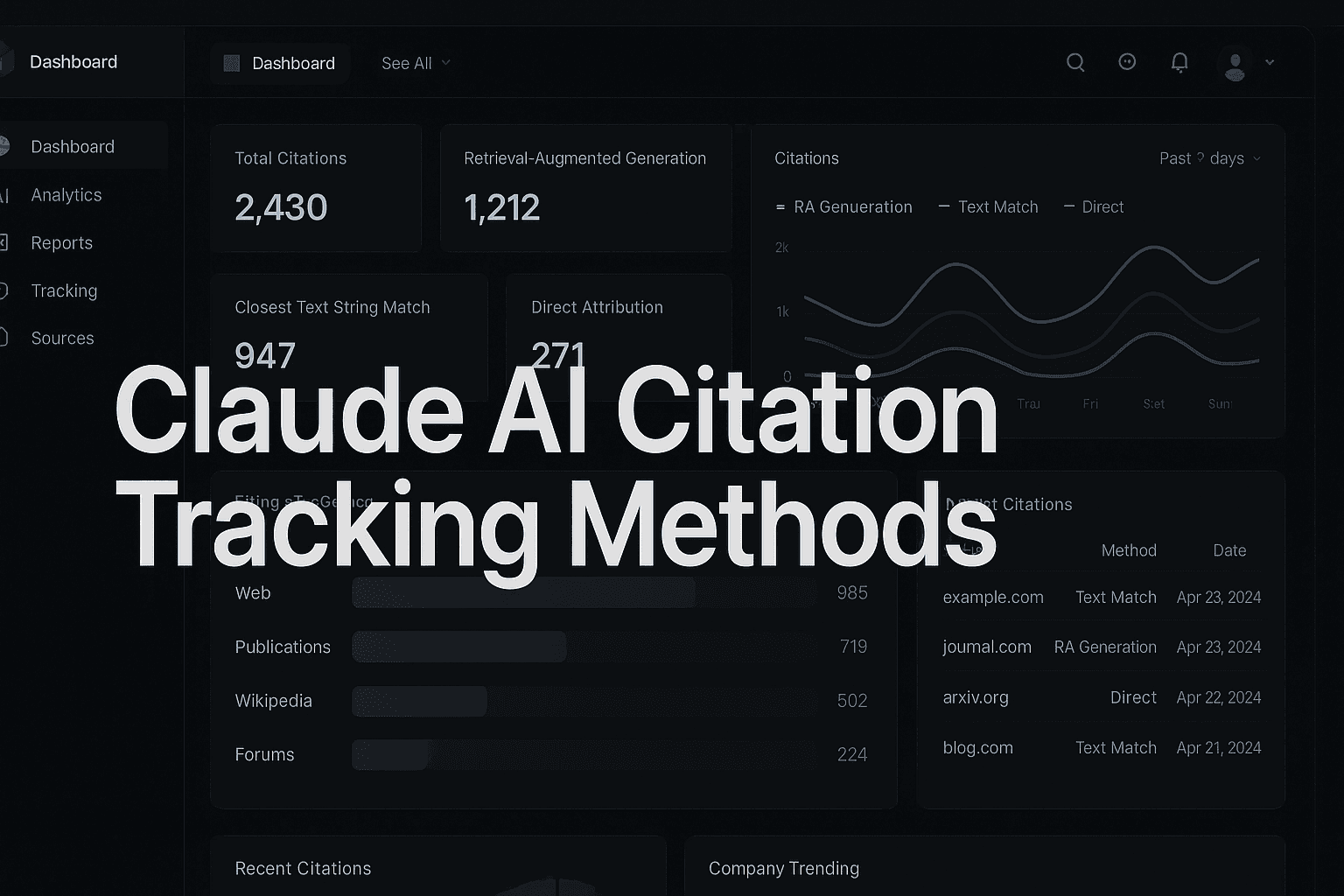
The integration of citation data with other AI visibility metrics creates comprehensive AI performance dashboards. Rather than tracking citations in isolation, future systems will combine citation data with AI-generated content mentions, AI search visibility, AI recommendation appearances, and AI-driven traffic. This ai visibility analytics dashboard approach provides a complete picture of your content's performance across the entire AI ecosystem.
Stop guessing how AI models like ChatGPT and Claude talk about your brand—get visibility into every mention, track content opportunities, and automate your path to organic traffic growth. Start tracking your AI visibility today and see exactly where your brand appears across top AI platforms.