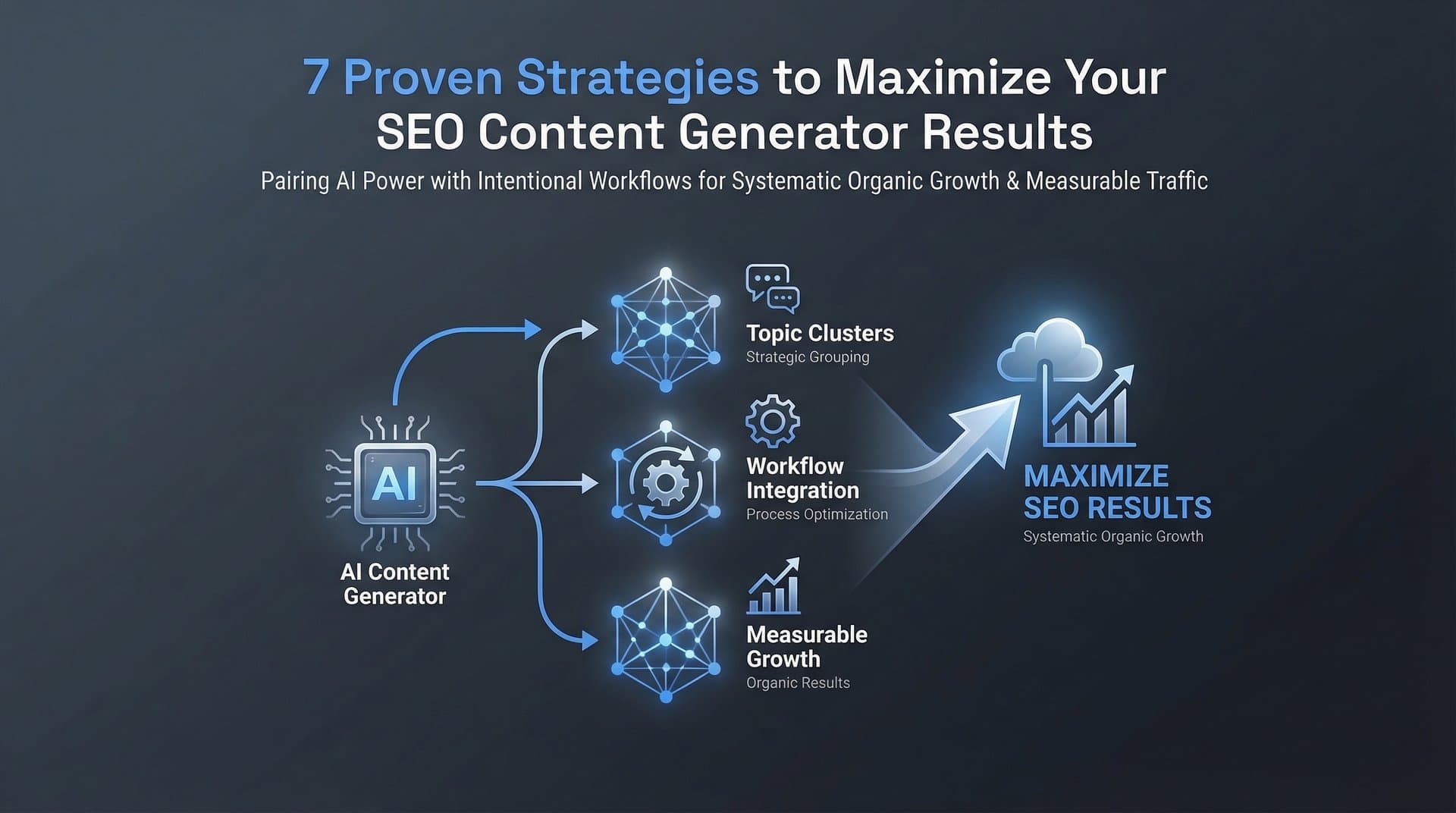
AI-powered blog post generators have transformed content marketing from a time-intensive bottleneck into a scalable growth engine. Yet many marketers treat these tools as simple "content vending machines"—input a keyword, output an article, publish, repeat. This approach leaves significant value on the table.
The difference between mediocre AI-generated content and high-performing articles that rank, engage, and convert lies in how strategically you deploy these tools. Many marketing teams find that their AI content programs succeed or fail based not on the technology itself, but on the processes and strategic thinking surrounding it.
This guide covers seven battle-tested strategies that help marketing teams, founders, and agencies extract maximum value from AI blog generators while maintaining quality standards that satisfy both search engines and human readers. Whether you're scaling content operations or optimizing existing workflows, these approaches will help you build a sustainable content engine that delivers consistent results.
1. Train Your AI Generator with Brand Voice Documentation
The Challenge It Solves
Generic AI-generated content sounds exactly like what it is—robotic, interchangeable, and forgettable. When every article reads like it could have come from any company in your industry, you lose the distinctive voice that builds reader trust and brand recognition. Your audience can spot the difference immediately, and so can search engines evaluating content quality signals.
Without proper brand voice training, AI generators default to bland, corporate-speak that fails to connect with your target audience. You end up spending hours rewriting content to inject personality, defeating the efficiency gains that made AI attractive in the first place.
The Strategy Explained
Think of brand voice documentation as the instruction manual your AI needs to write like your team. This goes far beyond telling the tool to "write professionally" or "be conversational." Effective brand voice guides include specific vocabulary preferences, sentence structure patterns, tone variations for different content types, and examples of what to avoid.
Create a comprehensive document that captures your brand's unique communication style. Include actual examples from your best-performing content, highlighting specific phrases, transitions, and structural approaches that define your voice. Document your terminology preferences—do you say "customers" or "clients"? "Platform" or "tool"? These seemingly small choices create consistency.
The most effective brand voice guides also include negative examples. Show your AI what you don't want: overly formal language, clichéd phrases, or jargon that alienates readers. Many teams find that providing both positive and negative examples dramatically improves output quality.
Implementation Steps
1. Audit your top-performing content to identify consistent voice patterns, recurring phrases, and structural approaches that define your brand's communication style.
2. Create a brand voice document that includes tone descriptors, vocabulary preferences, sentence structure guidelines, and 5-10 examples of excellent brand-aligned writing from your archive.
3. Test your brand voice guide by generating sample content with and without it, comparing outputs to identify where the documentation improves consistency and authenticity.
4. Refine your guide based on these tests, adding specific instructions that address gaps between your desired voice and what the AI produces naturally.
Pro Tips
Update your brand voice documentation quarterly as your communication style evolves. Include examples of how your voice shifts across different content types—your how-to guides might be more instructional while thought leadership pieces adopt a more authoritative tone. Store this documentation where your entire content team can access and reference it, ensuring consistency whether content comes from AI or human writers.
2. Layer Strategic Keyword Research Before Generation
The Challenge It Solves
AI generators can write about virtually any topic, but that versatility becomes a weakness without strategic direction. Teams often generate content based on gut feelings about what their audience wants, only to discover those articles target keywords with impossible competition or negligible search volume. You end up with well-written content that nobody finds.
The traditional approach of "write first, optimize later" wastes the AI's efficiency advantage. By the time you realize an article targets the wrong keywords, you've already invested time in generation, editing, and potentially publishing content that won't deliver results.
The Strategy Explained
Strategic keyword research should happen before you touch your AI generator, not after. This means identifying specific search opportunities where your content can realistically rank, understanding search intent behind those queries, and mapping keywords to appropriate content formats. Your AI becomes the execution engine for a human-led strategy.
Start by identifying keyword clusters—groups of related terms that address the same user need. Rather than targeting single keywords in isolation, build content around these clusters to capture multiple search variations. This approach helps AI generators create more comprehensive articles that naturally incorporate semantic variations.
Consider search intent carefully. A keyword like "AI blog generator" might have informational intent (users researching options), navigational intent (users looking for specific tools), or transactional intent (users ready to purchase). Your AI-generated content should match the intent behind your target keywords, which means different content formats and approaches for different keyword types.
Implementation Steps
1. Build keyword clusters by identifying primary target keywords and their related semantic variations, question-based queries, and long-tail opportunities that address the same user need.
2. Analyze search intent for each keyword cluster by reviewing top-ranking content to understand what format and depth users expect when searching these terms.
3. Create content briefs that include primary and secondary keywords, target search intent, required article structure, and key topics to cover before feeding these briefs to your AI generator.
4. Track ranking performance by keyword cluster rather than individual articles to understand which strategic approaches deliver the best results over time.
Pro Tips
Look for "content gaps"—topics your competitors haven't covered comprehensively where you can establish authority. Use your keyword research to identify these opportunities, then deploy your AI generator to fill gaps quickly while competition remains low. Many marketing teams find that targeting emerging topics with moderate search volume delivers better results than competing for established high-volume keywords.
3. Implement a Human-AI Collaborative Editing Workflow
The Challenge It Solves
The two extremes of AI content workflows both create problems. Publishing AI-generated content without human review produces generic articles that damage your brand credibility. Conversely, treating AI output as a rough draft that requires complete rewriting eliminates the efficiency gains that justified using AI in the first place.
Without clear processes defining where humans add value and where AI handles execution, teams waste time on low-value editing tasks while missing critical quality issues. Your content operations become bottlenecked by unclear handoffs and inconsistent quality standards.
The Strategy Explained
Effective human-AI collaboration defines specific checkpoints where human judgment adds maximum value. This isn't about editing every sentence—it's about identifying the strategic decision points where human expertise matters most. Think of it as directing a talented writer rather than rewriting their work from scratch.
The most successful workflows concentrate human effort on three areas: strategic direction (ensuring content aligns with business goals and audience needs), factual verification (confirming claims and checking for hallucinated information), and brand authenticity (adding unique perspectives and proprietary insights that AI cannot generate). Everything else—grammar, structure, basic optimization—the AI should handle.
Create a tiered review system based on content importance. High-priority articles targeting competitive keywords or addressing sensitive topics get comprehensive human review. Lower-priority content supporting long-tail keywords might need only quick fact-checking and brand voice verification. This approach scales your human resources efficiently.
Implementation Steps
1. Map your content workflow identifying specific handoff points between AI generation and human review, documenting what each review checkpoint should verify and what to ignore.
2. Create quality checklists for different content tiers so reviewers know exactly what to check based on article priority and complexity level.
3. Establish clear turnaround time expectations for each review stage to prevent bottlenecks where AI-generated content sits waiting for human attention.
4. Track time investment by workflow stage to identify where human effort concentrates and whether your process actually delivers the efficiency gains you expected.
Pro Tips
Build a "reject and regenerate" protocol for AI output that misses the mark entirely. Sometimes starting fresh with refined prompts takes less time than extensively editing poor initial output. Document patterns in rejected content to improve your prompt engineering over time, reducing the frequency of unusable generations.
4. Optimize for AI Search Visibility, Not Just Traditional SEO
The Challenge It Solves
Traditional SEO optimization focuses on ranking in Google search results, but that's increasingly only part of the discovery equation. AI assistants like ChatGPT, Claude, and Perplexity now answer millions of queries daily, often without users ever clicking through to websites. If your content isn't structured for AI discovery, you're invisible in this growing channel.
Content optimized solely for traditional search engines often lacks the clear, structured information that AI models need to confidently reference and recommend your brand. You might rank well in Google while remaining completely absent from AI assistant responses—missing opportunities to reach audiences who prefer conversational search interfaces.
The Strategy Explained
AI search optimization requires structuring content so AI models can easily extract, understand, and cite your information. This means clear hierarchical organization, direct answers to specific questions, and explicit attribution of claims to sources. Unlike traditional SEO where you optimize for ranking algorithms, here you're optimizing for comprehension and citability.
AI models prioritize content that provides clear, authoritative answers without requiring interpretation. This means front-loading key information, using descriptive headings that match natural language queries, and structuring articles so AI can extract specific facts or recommendations without parsing ambiguous prose. Think of it as writing for a highly intelligent but literal reader.
The emerging concept of GEO (Generative Engine Optimization) focuses specifically on making content discoverable and recommendable by AI assistants. This includes strategies like including your brand name and product descriptions in natural contexts, providing clear differentiation from competitors, and creating content that answers the specific questions users ask AI assistants.
Implementation Steps
1. Structure articles with clear, question-based headings that match natural language queries users might ask AI assistants about your topic area.
2. Include explicit brand and product mentions in natural contexts throughout your content so AI models understand what you offer and when to recommend you.
3. Create definitive, quotable statements that AI models can confidently cite when answering related queries, avoiding hedging language that makes your content less authoritative.
4. Test your content by asking AI assistants questions your target audience would ask, observing whether they reference your content and how they describe your brand.
Pro Tips
AI models value recency, so regularly update existing content with current information rather than only publishing new articles. Many teams find that refreshing high-performing content with 2026 data and insights improves AI visibility more effectively than creating entirely new pieces. Consider how AI assistants might summarize your key points—write with that use case in mind.
5. Automate Publishing and Indexing for Faster Discovery
The Challenge It Solves
Generating content quickly with AI loses its advantage when publishing and indexing create new bottlenecks. Many teams produce articles efficiently but then face manual processes for uploading to their CMS, formatting for their website, and waiting days or weeks for search engines to discover and index new content. Your competitive advantage evaporates in these delays.
Traditional indexing relies on search engine crawlers periodically checking your site for updates. For new or smaller sites, this can mean waiting weeks before fresh content appears in search results. By the time your AI-generated article gets indexed, competitors might have already captured the search visibility you were targeting.
The Strategy Explained
Modern content operations connect AI generation directly to publishing systems, eliminating manual upload and formatting steps. This automation extends beyond just posting articles—it includes automatic sitemap updates, IndexNow notifications that instantly alert search engines to new content, and even scheduled publishing that maintains consistent content velocity without manual intervention.
IndexNow represents a fundamental shift in how content gets discovered. Instead of waiting for search engines to crawl your site, you proactively notify them the moment new content publishes. Search engines like Bing and Yandex support this protocol, enabling near-instant indexing that gets your content into search results within hours instead of weeks.
The most sophisticated workflows combine generation, publishing, and indexing into single automated pipelines. You define content parameters and scheduling, then the system handles everything from AI generation through final publication and search engine notification. This level of automation lets small teams operate content programs that previously required dedicated publishing staff.
Implementation Steps
1. Connect your AI content generator to your CMS using available APIs or integration tools, eliminating manual content transfer and formatting steps.
2. Implement IndexNow integration to automatically notify search engines whenever new content publishes, dramatically reducing the time between publication and indexing.
3. Set up automated sitemap updates that refresh whenever new content goes live, ensuring search engines always have current information about your site structure.
4. Create publishing schedules that maintain consistent content velocity, using automation to space article publication strategically rather than publishing in irregular batches.
Pro Tips
Monitor your indexing speed by tracking time between publication and appearance in search results. This metric helps you understand whether your automation actually delivers faster discovery or if technical issues prevent proper indexing. Many teams find that combining IndexNow with traditional sitemap updates provides the most reliable indexing across different search engines.
6. Build Content Feedback Loops with Performance Data
The Challenge It Solves
Most teams generate AI content in a vacuum, never systematically analyzing which articles perform well and why. Without feedback loops connecting performance data back to content creation, you repeat the same approaches regardless of results. Your AI generates more content, but not necessarily better content.
The lack of data-driven iteration means you miss patterns that could dramatically improve results. Perhaps articles with certain structural approaches rank faster, or specific topic angles generate more engagement. Without tracking and analyzing these patterns, you're essentially guessing what works rather than building on proven successes.
The Strategy Explained
Effective feedback loops track multiple performance dimensions—not just rankings and traffic, but also engagement metrics, conversion rates, and increasingly, AI visibility metrics that show how often AI assistants reference your content. This comprehensive view helps you understand what "good performance" actually means for your specific goals.
The key is closing the loop between analysis and action. When you identify high-performing content patterns, document what made those articles successful and incorporate those elements into your AI generation prompts and brand voice guidelines. Your content system becomes self-improving, with each analysis cycle refining your approach.
Consider tracking AI visibility alongside traditional metrics. How often do AI assistants like ChatGPT, Claude, or Perplexity mention your brand when answering relevant queries? Which content pieces get cited most frequently? This emerging metric provides early signals about content quality and relevance that traditional SEO metrics might miss.
Implementation Steps
1. Define your performance metrics across multiple dimensions including search rankings, organic traffic, engagement rates, conversions, and AI assistant mentions.
2. Create a regular review cadence where you analyze top and bottom performers, identifying specific elements that correlate with success or failure.
3. Document successful patterns in your brand voice guidelines and content briefs so future AI-generated content incorporates these proven approaches.
4. Test hypotheses by deliberately varying specific elements in new content and measuring whether predicted improvements actually materialize in performance data.
Pro Tips
Look beyond surface metrics to understand why content performs well. An article with high traffic but low engagement might rank for the wrong keywords, while lower-traffic pieces with strong engagement signals might be excellent templates for future content. Many marketing teams find that their most valuable insights come from analyzing mid-performers that could be improved rather than just studying obvious successes and failures.
7. Scale Strategically with Content Calendars and Batch Processing
The Challenge It Solves
The ability to generate content quickly tempts teams into reactive, unplanned publishing that lacks strategic coherence. You end up with a random collection of articles rather than a comprehensive content library that systematically addresses your audience's needs. Individual pieces might be well-written, but they don't build toward larger business objectives.
Without planning and batching, content operations become chaotic. Team members generate articles on whatever topics seem interesting that day, creating gaps in important coverage areas while over-saturating others. Quality becomes inconsistent when you lack systematic processes for planning, generation, and review.
The Strategy Explained
Strategic scaling starts with comprehensive content calendars that map your publishing schedule to business goals and seasonal opportunities. Rather than generating content on demand, you plan topic clusters, keyword targets, and publication timing in advance. This forward-looking approach ensures your content library develops systematically rather than haphazardly.
Batch processing applies manufacturing principles to content creation. Instead of generating, editing, and publishing articles one at a time, you batch similar tasks together. Generate multiple articles in one session, then move to editing them as a group, then batch-publish according to your calendar. This approach dramatically improves efficiency by reducing context-switching overhead.
The most effective content calendars balance evergreen topics that provide lasting value with timely pieces that capitalize on current trends or seasonal search patterns. Plan your evergreen foundation in advance, leaving flexibility for opportunistic content that responds to emerging trends or competitive gaps you discover through ongoing research.
Implementation Steps
1. Create quarterly content calendars that map specific articles to business goals, keyword targets, and seasonal opportunities, ensuring comprehensive topic coverage.
2. Organize content generation into batches based on topic clusters or content types, allowing you to optimize AI prompts and maintain consistent quality standards within each batch.
3. Establish batch processing workflows where you complete similar tasks across multiple articles before moving to the next phase, reducing context-switching and improving efficiency.
4. Build buffer inventory by generating content ahead of your publishing schedule, giving you flexibility to respond to unexpected opportunities without disrupting your planned calendar.
Pro Tips
Review your content calendar monthly rather than treating it as fixed. Markets change, new opportunities emerge, and some planned topics might lose relevance. Many teams find that maintaining 60-70% planned content with 30-40% flexibility for opportunistic pieces provides the right balance between strategic consistency and tactical responsiveness. Use your performance data from feedback loops to continuously refine what topics and approaches deserve space in future calendars.
Putting It All Together
These seven strategies work best when implemented progressively rather than all at once. Start with the foundations that deliver immediate improvements—create your brand voice documentation and layer strategic keyword research into your process. These changes require minimal technical setup but dramatically improve output quality.
Next, establish your human-AI collaborative workflow and begin optimizing for AI search visibility. These mid-tier strategies require more process development but position your content for success across both traditional and emerging discovery channels. Many teams find that implementing these four foundational strategies within their first month creates noticeable improvements in content quality and efficiency.
Finally, tackle the advanced automation and scaling strategies. Connect your systems for automated publishing and indexing, build your performance feedback loops, and implement strategic content calendars with batch processing. These sophisticated approaches require more setup investment but enable true scale—the ability to produce high-quality, strategically aligned content at volumes that would be impossible with purely manual processes.
The key principle underlying all these strategies is treating AI as a collaborative tool rather than a replacement for human judgment. The most successful content operations leverage AI for what it does well—rapid generation, consistent formatting, comprehensive coverage—while preserving human oversight for what matters most: strategic direction, quality standards, and brand authenticity.
Remember that content performance increasingly depends on visibility across multiple channels. Traditional search rankings remain important, but AI assistants now influence how millions of users discover information and evaluate brands. Your content strategy needs to address both discovery paths, which means tracking performance across traditional SEO metrics and emerging AI visibility signals.
Stop guessing how AI models like ChatGPT and Claude talk about your brand—get visibility into every mention, track content opportunities, and automate your path to organic traffic growth. Start tracking your AI visibility today and see exactly where your brand appears across top AI platforms, then use those insights to refine your content strategy and maximize the value of your AI-powered blog post generator.