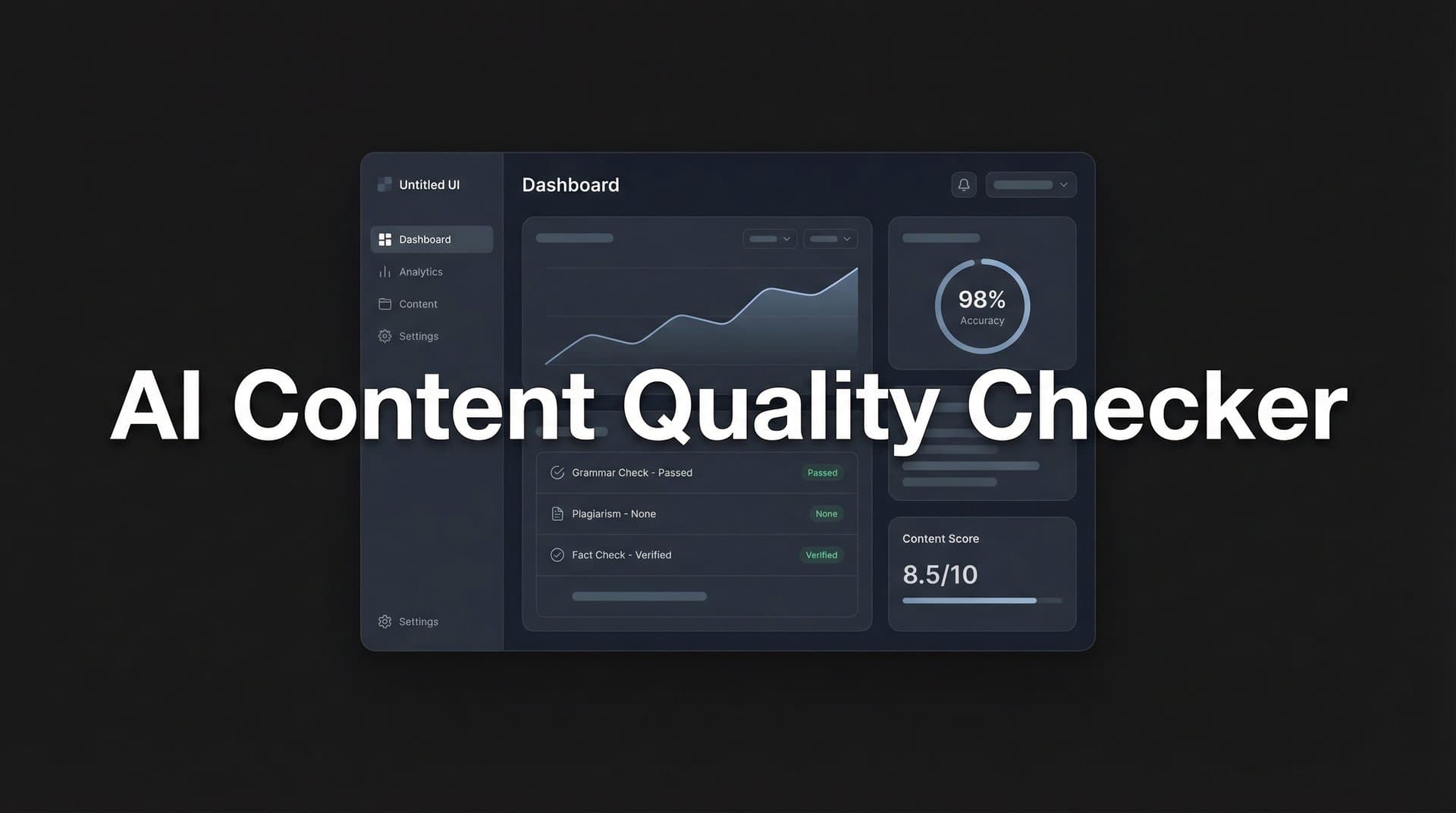
You've invested in an AI content quality checker, configured the settings, and started running your articles through it. Then reality hits: inconsistent scores across similar content, false positives flagging perfectly good paragraphs, and team members debating whether a 72% quality score is acceptable or needs revision. Sound familiar?
The challenge isn't the tool itself. Most AI content quality checkers offer powerful capabilities for evaluating grammar, readability, SEO alignment, and brand consistency. The real issue is how you use them.
Without a strategic framework, quality checking becomes either a bottleneck that slows publication or a checkbox exercise that teams ignore. Your content team needs clear guidelines on what constitutes "quality," when automated checks suffice versus requiring human review, and how to turn quality data into actionable improvements.
This gets even more complex as AI search platforms like ChatGPT, Claude, and Perplexity become significant discovery channels. Your content now needs to satisfy both traditional SEO requirements and the factual accuracy, structural clarity, and comprehensive coverage that AI models prioritize when deciding which sources to cite.
These seven strategies will help you transform your AI content quality checker from a source of confusion into a competitive advantage. You'll learn how to establish objective benchmarks, customize checks for your brand voice, integrate quality gates throughout your content lifecycle, and ensure your content performs in both traditional search and AI-powered discovery.
1. Establish Clear Quality Benchmarks Before You Check
The Challenge It Solves
Running content through a quality checker without predefined standards creates chaos. Your tool returns a score, but what does 68% actually mean? Is that publishable? Does it need minor tweaks or a complete rewrite? Without documented benchmarks, every quality discussion becomes subjective, team members make inconsistent decisions, and your content standards drift over time.
This ambiguity wastes time in two ways. Writers spend hours perfecting content that already meets your standards, while other pieces get published despite significant quality gaps because no one defined the threshold.
The Strategy Explained
Create a documented quality rubric before you evaluate a single piece of content. This rubric should define specific, measurable criteria across the dimensions your checker evaluates: readability level, grammatical accuracy, SEO optimization, brand voice alignment, and factual precision.
For each dimension, establish three tiers: minimum acceptable (what must be true for publication), target quality (your standard goal), and exceptional (what makes content stand out). Assign numerical ranges to each tier so your team can interpret scores consistently.
The most effective rubrics connect quality scores to business outcomes. If you know that articles scoring above 80% on readability generate 40% more social shares than those scoring 60-70%, that context helps writers understand why the benchmark matters.
Implementation Steps
1. Audit your ten best-performing published articles using your quality checker and document their scores across all dimensions to establish your baseline for success.
2. Define minimum thresholds for each quality dimension based on content type (blog posts might require 75% readability while technical documentation accepts 60%), then document these standards in a shared reference guide.
3. Create decision trees that map score ranges to specific actions, such as "70-79% requires senior editor review" or "below 60% returns to writer with specific improvement checklist."
Pro Tips
Start with conservative benchmarks and raise them gradually as your team adapts. Setting unrealistic initial standards creates frustration and resistance. Review and update your benchmarks quarterly based on performance data—what constituted "exceptional" six months ago might become your new minimum as your team's capabilities improve.
2. Layer Multiple Quality Dimensions in Your Review Process
The Challenge It Solves
Many teams run content through a quality checker once, get an overall score, and make publication decisions based on that single number. This approach misses critical nuances. An article might score well on grammar and readability but completely miss your SEO targets. Another piece might nail keyword optimization while sounding nothing like your brand voice.
Single-pass checking also makes it difficult to prioritize improvements. When everything appears as one blended score, writers don't know whether to focus on fixing sentence structure, adding keywords, or adjusting tone first.
The Strategy Explained
Design a sequential workflow that evaluates different quality dimensions separately, allowing your team to address each aspect systematically. Think of this as multiple specialized filters rather than one catch-all screen.
Your first pass should focus on technical accuracy: grammar, spelling, factual claims, and link validity. These are objective, binary issues that AI checkers handle well. Once technical accuracy reaches your threshold, move to readability and engagement: sentence variety, paragraph length, transition quality, and hook effectiveness.
The third layer examines SEO alignment: keyword integration, heading structure, meta optimization, and internal linking. Your final pass evaluates brand consistency: voice, terminology, messaging alignment, and compliance with style guidelines. This separation prevents you from trying to fix everything simultaneously, which often leads to unfocused revisions.
Implementation Steps
1. Map your quality dimensions to specific team roles or review stages, such as assigning technical accuracy checks to writers, SEO alignment to your content strategist, and brand consistency to editors.
2. Create a progression workflow where content must pass each dimension before advancing to the next, preventing partially-complete pieces from reaching later stages and wasting senior team members' time.
3. Configure separate quality check templates for each dimension in your tool, focusing the evaluation criteria and making results more actionable than generic overall scores.
Pro Tips
Document the order of your quality layers based on efficiency, not importance. Technical accuracy comes first because fixing grammar often changes word count and keyword density, which would invalidate your SEO checks if done in reverse order. Track how long each dimension takes to review and optimize your slowest bottleneck first.
3. Train Your Quality Checker on Brand-Specific Parameters
The Challenge It Solves
Generic quality checkers evaluate content against broad, universal standards. They flag industry terminology as jargon, suggest simplifying your carefully-crafted brand voice, and miss context-specific quality issues that matter to your audience. Your SaaS company's technical documentation gets dinged for complexity that your developer audience expects and values.
This creates false positives that erode trust in the tool. When your quality checker consistently flags correct usage as errors, team members start ignoring all its feedback, including legitimate issues that need fixing.
The Strategy Explained
Customize your AI content quality checker with brand-specific rules, approved terminology, style preferences, and industry context. Most advanced checkers allow you to upload style guides, create custom dictionaries, and define acceptable exceptions to standard grammar rules.
Start by documenting your brand voice characteristics. If your tone is conversational and direct, configure the checker to accept sentence fragments and contractions that formal writing would flag as errors. If you serve a technical audience, adjust readability thresholds to accommodate necessary complexity.
Build a terminology database that includes your product names, industry-specific terms, competitor names, and technical vocabulary your audience expects. This prevents the checker from flagging specialized language as readability issues while still catching actual jargon that confuses readers.
Implementation Steps
1. Extract terminology, style preferences, and voice guidelines from your existing brand style guide and format them as custom rules in your quality checker's configuration settings.
2. Analyze the last 20 false positives your team reported and create specific exceptions for each valid pattern the tool incorrectly flagged, such as allowing industry acronyms or accepting longer sentences when explaining complex concepts.
3. Establish a feedback loop where team members can flag incorrect quality assessments, then review these reports monthly to refine your custom parameters and improve accuracy over time.
Pro Tips
Version control your custom quality parameters just like you would code. When you make configuration changes, document what you adjusted and why, then monitor how those changes affect quality scores over the next two weeks. This lets you roll back modifications that create unintended consequences. Assign one team member as the quality checker administrator responsible for maintaining and updating custom parameters.
4. Integrate Quality Checks at Multiple Content Lifecycle Stages
The Challenge It Solves
Most teams only check content quality immediately before publication. By this point, structural issues require major rewrites, missed SEO opportunities can't be recovered without starting over, and deadline pressure forces teams to publish subpar content rather than delay.
Pre-publication checking also misses quality degradation over time. Links break, statistics become outdated, and competitors publish better content on the same topics, but you never know because you only checked quality once.
The Strategy Explained
Build quality gates into four distinct content lifecycle stages: outline approval, draft completion, pre-publication review, and post-publication monitoring. Each gate serves a different purpose and catches different types of issues.
At the outline stage, check for topic relevance, keyword targeting clarity, and structural completeness. This takes 30 seconds but prevents writers from investing hours in content that misses strategic objectives. When the draft is complete, run comprehensive quality checks across all dimensions to identify issues while there's still time for substantial revision.
Your pre-publication gate performs final validation: broken links, formatting consistency, meta tag completion, and compliance with current brand guidelines. Post-publication monitoring runs quarterly checks on existing content to catch link rot, outdated claims, and declining performance relative to newer competitor content.
Implementation Steps
1. Create stage-specific quality check templates that focus each review on issues relevant to that lifecycle phase, such as checking only structure and keyword targeting at the outline stage rather than running full grammar analysis on bullet points.
2. Define minimum quality scores required to advance from each stage, preventing content from moving forward with known issues that will only become more expensive to fix later in the process.
3. Schedule automated post-publication quality checks that re-evaluate your top 20% of traffic-driving articles every 90 days, flagging pieces that need updates before they lose rankings or start providing outdated information.
Pro Tips
Weight your quality gates by impact and effort. Outline checks should be fast and forgiving because you're evaluating incomplete work. Pre-publication checks should be rigorous because fixing issues costs minimal time. Post-publication checks should focus exclusively on high-value content where updates justify the investment. Track your catch rate at each stage to identify where most issues originate and address root causes.
5. Use Quality Data to Identify Systemic Content Issues
The Challenge It Solves
Treating each quality check as an isolated event misses the bigger picture. When five different articles all score poorly on readability, that's not five separate problems—it's one systemic issue with how your team writes or how your writers are trained. You keep fixing symptoms instead of addressing root causes.
Without aggregated quality data, you also can't measure improvement over time or identify which writers need additional training versus which are consistently producing high-quality work.
The Strategy Explained
Transform your quality check results from individual pass/fail assessments into a strategic dataset that reveals patterns, trends, and opportunities. Export quality scores into a spreadsheet or dashboard where you can analyze performance by writer, content type, topic category, and publication date.
Look for recurring issues that affect multiple pieces. If readability consistently scores low across all technical tutorials, you might need to revise your tutorial template or provide specific training on explaining complex concepts clearly. If SEO scores are strong but engagement metrics are weak, your keyword targeting might be attracting the wrong audience.
Compare quality scores against performance metrics. Do articles scoring above 85% on brand voice consistency generate more repeat visitors? Does higher factual accuracy correlate with better rankings in AI search results? These insights help you prioritize which quality dimensions actually drive business outcomes.
Implementation Steps
1. Create a quality tracking dashboard that logs every content piece's scores across all dimensions, tagged with metadata like writer, content type, target keyword, and publication date for multidimensional analysis.
2. Run monthly quality audits that identify the three most common issues across all content checked that month, then create targeted training or process improvements to address those specific patterns.
3. Correlate quality scores with performance data by comparing average quality metrics for your top 25% performing content versus bottom 25%, revealing which quality dimensions actually predict success for your audience.
Pro Tips
Share quality trends transparently with your content team, but focus on patterns rather than individual performance to avoid creating a punitive atmosphere. When you identify that "articles with quality scores above 80% generate 3x more backlinks," that motivates improvement better than "your quality scores are below average." Use quality data to celebrate wins and identify best practices from your top performers that others can learn from.
6. Balance Automation with Human Editorial Judgment
The Challenge It Solves
Over-reliance on automated quality scores creates two opposite problems. Some teams treat AI checker scores as absolute truth, rejecting content that scores 78% even when human readers find it compelling and effective. Other teams ignore quality check results entirely after experiencing too many false positives, eliminating any value from the tool.
AI quality checkers excel at objective technical assessment but struggle with subjective elements like emotional resonance, strategic positioning, and creative differentiation that often make content memorable and shareable.
The Strategy Explained
Establish clear decision boundaries that define when automated quality checks are sufficient versus when human editorial judgment must override or supplement the score. Create a framework that leverages AI efficiency for objective criteria while preserving human expertise for nuanced evaluation.
For technical dimensions like grammar, spelling, and link validity, automated checks should be authoritative. If the tool flags a broken link or misspelled word, fix it. For readability and SEO, use automated scores as guidelines that suggest improvements but allow editors to make final calls based on audience and context.
For brand voice, strategic messaging, and creative execution, human editors should have veto power over automated assessments. An article might score low on "readability" because it uses sophisticated vocabulary your educated audience expects and appreciates. Your editor understands this context; your quality checker doesn't.
Implementation Steps
1. Create an authority matrix that explicitly states which quality dimensions are "automated final" versus "automated advisory" versus "human final," eliminating ambiguity about when team members can override quality check recommendations.
2. Implement a two-tier review system where content scoring above your automated threshold publishes directly, while content between your minimum and target thresholds requires human editorial review before publication.
3. Document override patterns by tracking when editors approve content despite low automated scores and why, then use this data to refine your quality checker's custom parameters and reduce future false positives.
Pro Tips
Train your team to articulate why they're overriding an automated quality assessment. "I disagree with the score" isn't sufficient; "This technical terminology is necessary for our developer audience despite the readability flag" demonstrates strategic thinking. These documented overrides become training data that helps you improve your quality checker's configuration over time. Establish escalation paths for disagreements between automated scores and human judgment.
7. Optimize for AI Visibility and Search Discovery Simultaneously
The Challenge It Solves
Traditional content quality checks focus exclusively on human readers and search engine crawlers. They evaluate keyword density, meta descriptions, and heading structure for Google's algorithm. But they miss critical factors that determine whether AI models like ChatGPT, Claude, and Perplexity cite your content when answering user queries.
As AI search becomes a significant discovery channel, content that only optimizes for traditional SEO leaves visibility opportunities on the table. Your articles might rank well in Google but never get mentioned by AI models, cutting you off from a growing segment of search traffic.
The Strategy Explained
Expand your quality checking criteria to include factors that AI models prioritize when selecting sources: factual accuracy with clear attribution, comprehensive topic coverage, structured information presentation, and content freshness. These elements overlap with good SEO practices but require different emphasis.
AI models favor content that presents information in clear, scannable formats. They look for articles that answer questions directly, provide supporting evidence, and acknowledge limitations or alternative viewpoints. Your quality checker should evaluate whether your content includes these elements, not just whether it hits keyword targets.
Factual precision matters more in AI search than traditional SEO. While Google might rank content based on authority signals and backlinks, AI models evaluate the accuracy and specificity of claims. Your quality check should flag unsupported statistics, vague assertions, and outdated information that might pass traditional SEO review but fail AI scrutiny.
Implementation Steps
1. Add AI visibility criteria to your quality rubric including claim verification (every statistic cites a source and date), structural clarity (key information appears in scannable formats), and comprehensiveness (content addresses related questions users might ask).
2. Configure your quality checker to flag content that lacks specific elements AI models value, such as clear definitions of key terms, acknowledgment of alternative perspectives, and explicit answers to common questions about your topic.
3. Cross-reference your quality check results with actual AI visibility data by monitoring which of your articles get cited by ChatGPT, Claude, and other AI platforms, then analyze what quality characteristics correlate with higher citation rates.
Pro Tips
Don't treat AI optimization and traditional SEO as competing priorities—they're complementary. Content that clearly answers questions, cites sources, and provides comprehensive coverage tends to perform well in both traditional search and AI citations. Focus on creating genuinely helpful, accurate content rather than trying to game either system. Monitor how AI models describe your brand and cite your content to identify which quality factors actually influence their selection process for your specific industry and topics.
Putting It All Together
The difference between teams that struggle with AI content quality checkers and those that leverage them effectively comes down to strategy, not technology. Your tool is only as valuable as the framework you build around it.
Start with the foundation: establish clear, documented quality benchmarks before you check a single article. This eliminates subjective debates and creates consistency across your team. Then layer your quality dimensions so you're evaluating technical accuracy, readability, SEO, and brand voice as separate but interconnected elements rather than one blended score.
As you gain experience, customize your quality checker with brand-specific parameters that reduce false positives and make feedback more relevant. Integrate quality gates throughout your content lifecycle to catch issues early when they're easiest to fix. Use the data you're generating to identify systemic problems rather than treating each quality issue in isolation.
The teams seeing the best results recognize that quality checking isn't about achieving perfect scores. It's about maintaining standards that build audience trust while producing content efficiently enough to compete in your market. They balance automated efficiency with human editorial judgment, knowing that some quality dimensions require context and expertise that AI can't provide.
Perhaps most importantly, they're adapting their quality standards for the emerging reality of AI search. Traditional SEO optimization remains essential, but it's no longer sufficient. Your content needs to satisfy both Google's crawlers and ChatGPT's citation logic, both human readers and AI models evaluating your factual accuracy and comprehensiveness.
This is where visibility becomes your competitive advantage. While you're optimizing content quality, you should also be monitoring how AI models actually talk about your brand. Are they citing your articles? Recommending your products? Describing your company accurately? Start tracking your AI visibility today and see exactly where your brand appears across top AI platforms. Understanding your current AI visibility helps you refine your quality standards based on what actually drives citations and mentions, creating a feedback loop between content quality and discovery.
The content landscape has fundamentally changed. Quality checking can't just prevent errors anymore—it needs to actively position your content for discovery in both traditional search and AI-powered answers. Implement these seven strategies systematically, measure what actually moves your visibility metrics, and iterate based on results. That's how you transform quality checking from a bottleneck into the strategic advantage that separates growing brands from stagnant ones.